
How to Practice Pickleball Solo
Finding time to practice with a partner can be challenging. Solo practice gives you complete control over your training schedule and allows you to focus on specific skills that need improvement.
In a typical doubles match, you might get 50 to 100 touches on the ball over an hour. In 15 minutes of focused wall drills, you can get over 200 touches, each one targeting exactly what you want to improve.
Here are three proven methods to transform your game on your own.
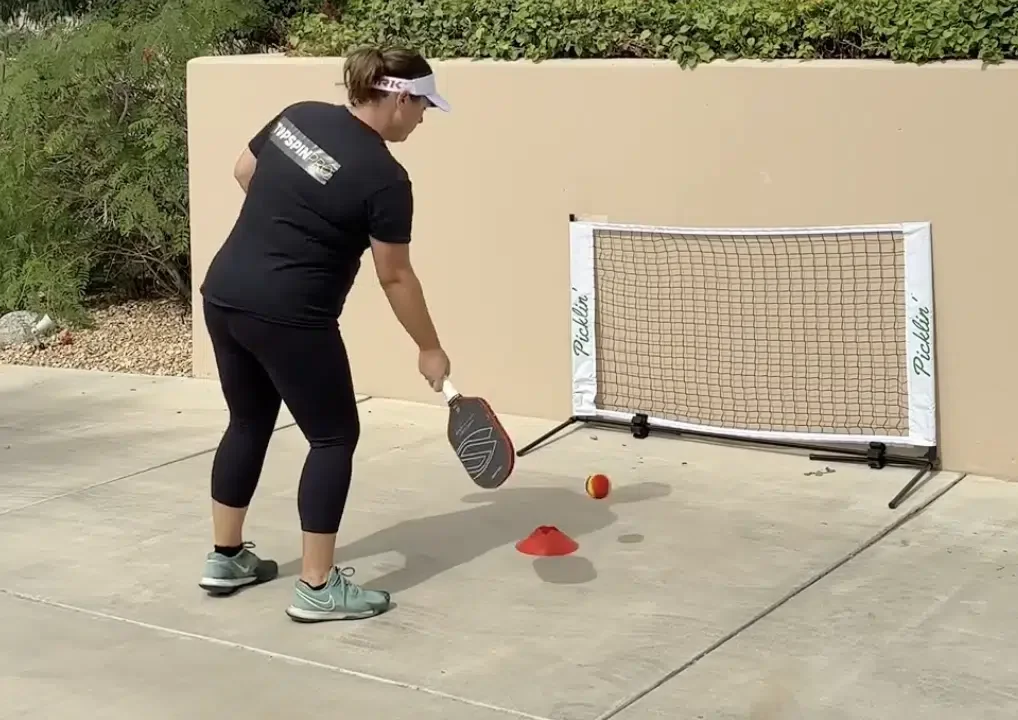
Source : Top Spin Pro
1. Wall Drills for Consistent Touch
Wall drills provide instant feedback and allow you to get hundreds of repetitions in a short practice session. The wall returns every shot, letting you focus purely on technique.
Setting Up Your Practice Wall
Find any solid flat surface like a garage wall or the side of your house. You need two pieces of tape:
Place a horizontal line of tape 36 inches from the ground to simulate the net height.
Mark a line on the ground 7 feet from the wall to represent your kitchen line.
The Dinking Drill
Stand just outside your marked kitchen line. Drop the ball, let it bounce once, then gently hit it so it arcs over the net line and returns to you.
Focus on keeping your paddle face slightly open and using a lifting motion rather than a swing. Make contact in front of your body with soft, controlled touches.
Try to maintain a rally with yourself, keeping the ball bouncing consistently. Start with a goal of 20 consecutive dinks, then work up to 50 or more. The slower and more controlled you can keep the rally going, the better your touch becomes.
Wall practice gives you 12 times more touches than three hours of doubles play. Without the pressure of a game situation, you can build correct muscle memory that transfers directly to match performance.
2. Target Practice for Accurate Serves
Your serve is the only shot in pickleball where you have complete control. A well-placed serve puts your opponent on defense immediately and sets up easier third shots.
Setting Up Your Targets
Grab a bucket of at least 50 balls and head to a court. You'll need some cones, towels, or tape to mark target zones in the service box.
Place markers in the deep corners of the opponent's service box. These are your primary targets because deep serves force opponents back and create weak returns.
Create an additional target in the center-back area of the service box.
The Deep Corner Drill
Start by serving to the deep right corner. Hit 10 serves, aiming to land the ball within two feet of your target marker.
Switch to the deep left corner and repeat with 10 more serves.
Finish with 10 serves to the center-back target.
Track how many serves out of 10 land near each target. Your goal is to hit 7 out of 10 in each zone. Once you can do this consistently, move your targets to create smaller landing zones.
This drill builds the accuracy you need to exploit your opponent's weaknesses. After two weeks of dedicated serving practice with three to four sessions, most players see 40 to 50 percent improvement in serve accuracy.
3. Footwork Drills for Better Court Position
Good footwork gets you to the ball in time and in the right position to make effective shots. You can practice movement patterns anywhere, including your driveway, backyard, or living room.
Setting Up Your Practice Space
You need a line to represent the kitchen line. Use tape, a rope, or simply imagine a line on the ground.
Make sure you have about 15 feet of lateral space to move side to side.
Clear the area of any obstacles.
The Lateral Shuffle Drill
Start at the left side of your practice area in ready position. Your knees should be bent, weight on the balls of your feet, and feet shoulder-width apart.
Shuffle across to the right side, staying low in your athletic stance. Your feet should never cross or come together. Take small, quick steps while maintaining balance.
When you reach the right side, immediately shuffle back to the left.
Continue this pattern for 60 seconds, then rest for 20 seconds. Complete three sets.
Add shadow dinking motions as you move to simulate a real rally. Practice your dink swing on alternating sides as you shuffle back and forth across the line.
This drill builds the lateral quickness needed during dinking exchanges at the kitchen line. Players who dedicate just 10 to 15 minutes per day to footwork drills report feeling more balanced and reaching more balls within one week of consistent practice.
Creating Your Practice Routine
Combine these three elements into a regular practice schedule. Even 30 minutes three times per week will produce noticeable improvements in your game.
A simple session might include 10 minutes of wall drills, 10 minutes of serving practice, and 10 minutes of footwork. Adjust the time based on which skills need the most attention.
The key is consistency. Regular solo practice builds muscle memory and confidence that carries directly into your matches. Track your progress by noting how many consecutive dinks you can maintain, what percentage of serves hit your targets, and how comfortable your footwork feels.
Solo practice gives you control over your improvement. You can work on specific weaknesses, repeat difficult skills until they become natural, and build the foundation that makes you a stronger player.
Grab your paddle and start practicing. Small improvements add up quickly when you're putting in focused work on your own.