
Who Takes the Middle Ball in Competitive Doubles?
It is one of the most common sights on a pickleball court: a ball floats perfectly down the centre line, and both partners either collide in a tangle of paddles or stand frozen, watching the ball bounce away as they exchange an awkward "I thought you had it" glance.
Most club players are taught a singular, golden rule to avoid this: "Forehand takes the middle." It sounds logical. Because most players possess a stronger, more offensive forehand than backhand, it makes sense to let that wing dominate the centre of the court.
However, as you move from the 3.0 level toward 4.5, you quickly realise that this "rule" is often a myth that can do more harm than good. In high-level competitive doubles, the best teams replace blanket rules with "middle ownership" systems based on court positioning, momentum, and clear communication.
Position Beats Stroke: The Core Principle
The most important shift in mindset for a developing player is understanding that position beats stroke. A mediocre backhand hit from a balanced, stable position is almost always better than a powerful forehand hit while lunging or off-balance.
We define the "better-positioned" player as the one who is balanced, closer to the ball’s natural flight path, and crucially not exposing a massive gap behind them. If the left-side player (the forehand in the middle) has to reach three feet across the centre line to poach a ball, they leave their entire wide sideline exposed. At higher levels, savvy opponents will bait that reach just to flick the next ball into the vacant alley. In these instances, it is far more efficient for the right-side partner to take a compact, stable backhand.
When the Forehand Rule Actually Works
This is not to say the forehand should never take the lead. In recreational play or lower-advanced brackets, having the left-side player own the middle is highly efficient when both players are right-handed and set at the Non-Volley Zone (NVZ).
This setup allows the more aggressive player to drive, roll, or attack high balls with their strongest weapon. This is the logic behind "stacking"—a strategy where teams shift positions so the dominant attacker stays on the left. In these systems, the left-side player is often expected to cover 60 to 75 per cent of the court, hunting for middle balls to put away.
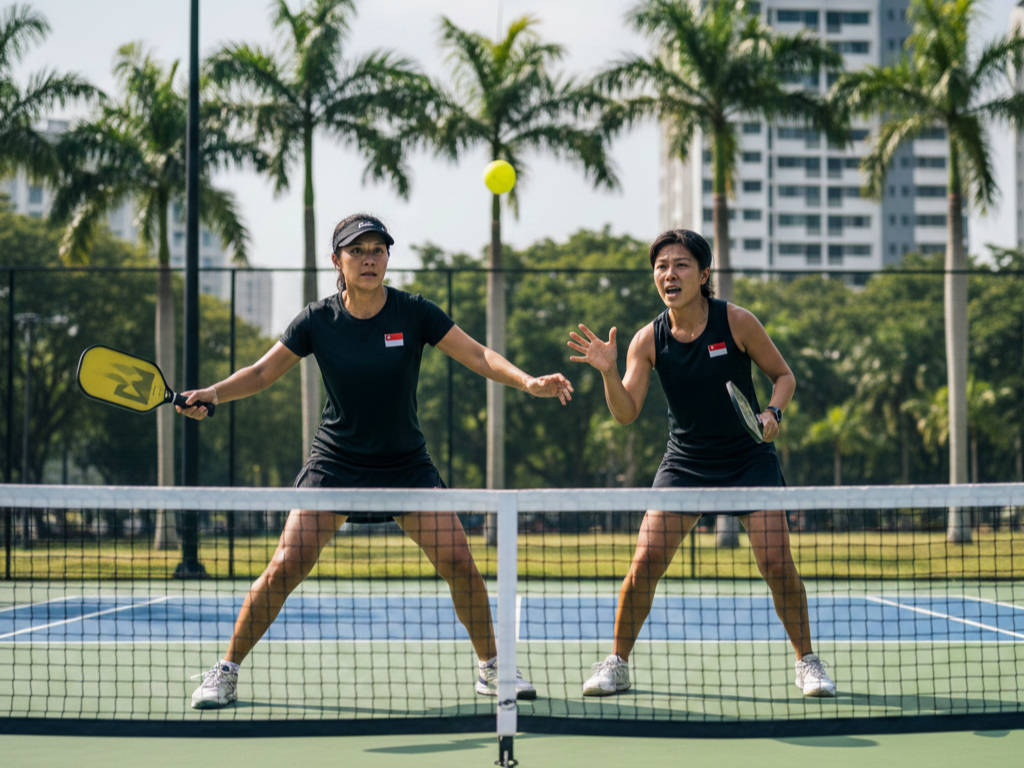
Where the Myth Breaks Down
The "forehand rule" fails the moment a player is stretched or "pulled wide." If the forehand player is scrambling to cover a sideline dink, they cannot be expected to sprint back to cover the middle.
Middle dinks are a perfect example. Professional teams often let the partner who is "neutral" (meaning they are already set and still) take the middle dink, even if it requires a backhand. This maintains the team's structural integrity. By avoiding "hero reaches," both players stay in their respective lanes, ready for the next shot rather than recovering from a collision.
Stacking and Team Design
Modern doubles strategy uses stacking to simplify these decisions. When a right-handed and left-handed player pair up, they often stack so that both forehands are in the middle. This is the "Gold Standard" of middle ownership because it removes the backhand weakness entirely.
In a righty-righty pairing, stacking the stronger attacker on the left side clarifies ownership: that player is the "designated hitter." However, even in these systems, the "Yours/Mine" communication remains the ultimate tiebreaker for balls that fall directly on the line.
Practical Communication Rules
To move beyond the "after you" moments, you must establish pre-match agreements. Try these three rules with your partner:
The NVZ Rule: The left-side player owns any "attackable" (high) middle ball, but the right-side player takes "neutral" (low) middle balls if they are closer.
The "Early Call" Rule: A decisive call is better than a correct technical choice. If you shout "Mine!" early, your partner must yield, even if the "rule" says it was theirs.
The Third Shot Rule: On the serve return, the player with the more reliable "third shot drop" should often slide toward the middle to take a deep return, regardless of which side it is on. This ensures the team gets to the kitchen safely.
Training for Middle Ownership
You can improve your team's chemistry with two simple drills:
The Middle-Call Dink Drill: Practice crosscourt dinking with your partner. Occasionally, have a feeder send a ball directly down the middle. You must agree beforehand who takes it, but the player must call "Mine" before making contact.
The "No-Reach" Game: Play a practice game where you imagine a vertical pane of glass on the centre line. If a player reaches more than a foot across that line to "steal" a ball from their partner, they lose the point. This reinforces discipline and teaches you to trust your partner’s backhand.
By moving away from the "forehand takes all" mentality and toward a system of better positioning and loud communication, you will find your team is much harder to break down. Stop worrying about which stroke is "better" and start focusing on which player is ready.
